Inverter vs. Regular Split AC in Saudi Heat: Electricity Savings, T3 Limits & Repairs
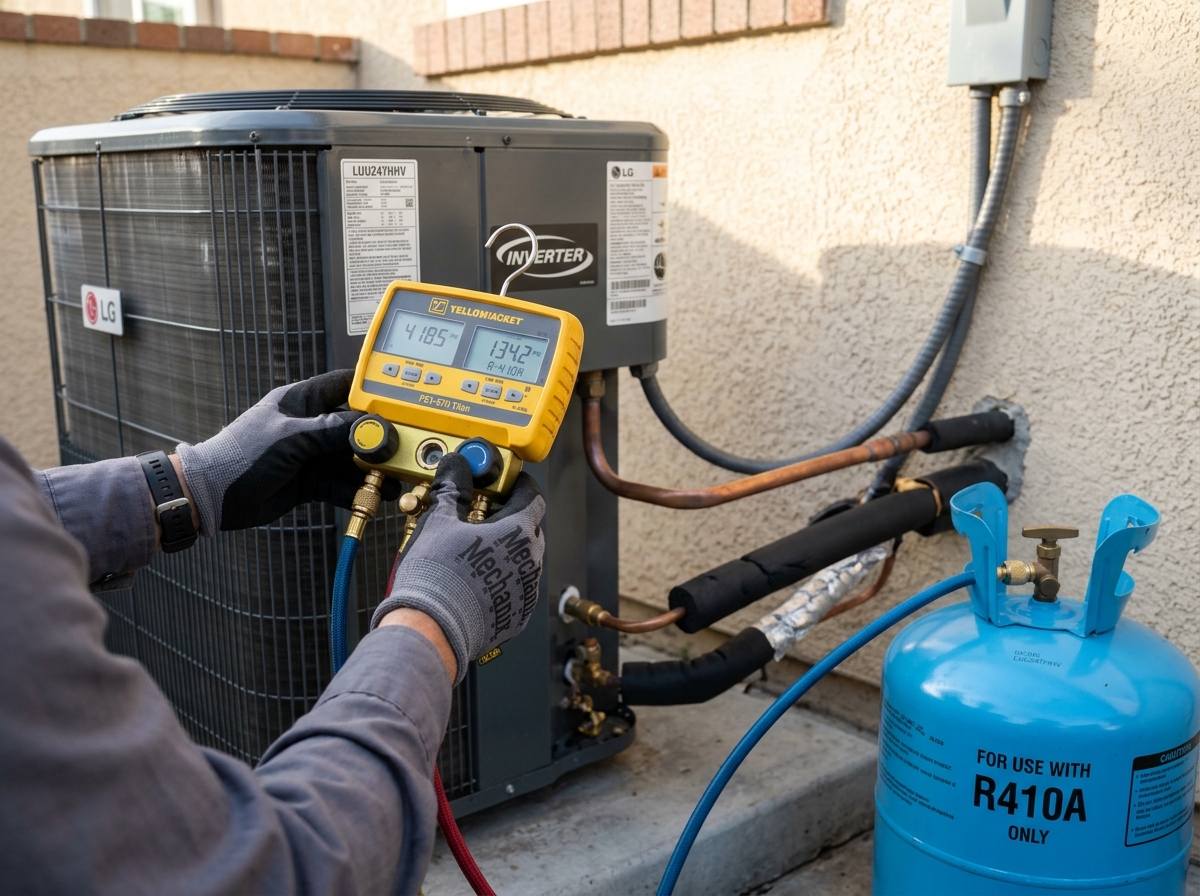
Inverter split ACs reduce electricity consumption by 30% to 45% in Saudi bedrooms and offices operating 8+ hours daily by modulating compressor speed instead of harsh stop-start cycles. Always choose Tropical T3 models with refrigerant-cooled IPM boards to survive ambient heat above 50°C.
Core Mechanical Difference: Fixed-Speed Rotary vs. Variable-Frequency Inverter
Choosing the right cooling architecture is one of the highest-impact decisions for Saudi property owners, given summer heat pushing past 48°C inland, heavy Red Sea humidity in Jizan and Sabya, and sharp seasonal temperature swings across Asir mountain cities like Abha and Khamis Mushait.
A traditional fixed-speed compressor operates strictly on an On/Off cycle. Once set to 22°C, the motor runs at 100% capacity until room air drops below target, shuts off completely, and restarts violently when indoor heat creeps up by two degrees—drawing massive locked-rotor inrush currents up to five times steady running amperage on every restart.
By contrast, an Inverter system pairs a brushless DC motor (BLDC) with a variable-frequency drive (VFD) board that smoothly dials compressor RPM between 10% and 120% capacity. Once your bedroom reaches target comfort, the unit throttles down to whisper-quiet maintenance speed, eliminating power spikes and holding room comfort within ±0.5°C.
- Conventional Rotary AC: Binary 0% or 100% power mode, 2–3°C temperature swings, and heavy electrical surge upon every restart.
- Inverter BLDC AC: Continuous frequency modulation from 15 to 120 Hz, tight ±0.5°C stability, and soft electrical ramp-up.
- Acoustic Comfort: Inverter indoor blowers drop to 19–26 dB during low-speed night operation versus 38–45 dB on conventional splits.
Electricity Bill Savings & Return on Investment (ROI) in Saudi Homes
According to Saudi Energy Efficiency Center (SEEC) benchmarks, air conditioning accounts for more than 65% of residential summer electricity consumption between May and October. Evaluating running kilowatt-hours matters far more over five years than initial purchase price.
In master bedrooms, nurseries, and full-day offices running 10 to 16 hours daily, inverter units routinely trim utility consumption by 90 to 150 SAR per month per 2-ton unit—recovering their higher showroom sticker price inside 14 to 18 months.
Conversely, in formal guest majlis halls or spare rooms operated less than two to three hours weekly, fixed-speed compressors rarely remain running long enough for low-frequency savings to materialize, stretching payback past 5 years.
| Comparison Factor | Inverter Split AC (Tropical T3) | Standard Fixed-Speed Split AC |
|---|---|---|
| Average Purchase Price | 2,700 - 3,900 SAR | 1,800 - 2,500 SAR |
| SEER Efficiency Rating | High-Tier Green (16.5 - 19.5) | Economy Standard (11.5 - 13.8) |
| Daily Energy Draw (12 hrs use) | 14 - 18 kWh | 26 - 34 kWh |
| Monthly SEC Bill Savings | 90 - 150 SAR / unit | Baseline Reference |
| Extreme Heat (+50°C) Tolerance | Requires T3 spec & cooled IPM board | Heavy-duty piston or tropical rotary |
| Control Board (PCB) Repair | 600 - 1,200 SAR if board fails | 180 - 350 SAR capacitor/relay |
| Expected Compressor Lifespan | 10 - 14 Years (with clean voltage) | 7 - 10 Years |
Surviving Extreme 50°C Saudi Heat, Dust & Voltage Fluctuations
Outdoor condenser cabinets in Saudi Arabia endure punishing thermal stress—from 49°C desert sandstorms in Hafar Al-Batin and Bisha to heavy coastal salt mist in Jizan. Inverter splits house sophisticated insulated outdoor power electronics (IPM Inverter Boards) exposed directly to rooftop sun.
Unless an inverter split carries an authentic Gulf Tropical T3 certification with refrigerant-pipe cooling across its IPM heatsink, budget boards throttle power sharply or trip error codes once rooftop cabinet temperatures top 52°C.
Top Cleaners engineers advise homeowners in extreme heat zones to select verified T3 inverter units paired with Gold Fin coils, solid building earthing, and ventilated overhead shading.
- Verify Tropical T3 Nameplate: Guarantees sustained cooling capacity up to 52°C without premature frequency throttling.
- Refrigerant-Cooled IPM Boards: Keeps sensitive power transistors cool using circulating liquid refrigerant lines.
- Voltage Surge Protection: Prevents costly outdoor PCB failures in outer neighborhoods experiencing voltage sags.
Maintenance Complexity & Decision Matrix for Your Building
Conventional split units run on straightforward electromechanical capacitors and relays that almost any technician can test quickly. Modern inverter units behave like miniature thermal computers relying on multiple thermistors, electronic expansion valves (EEVs), and serial communication buses between indoor and outdoor PCBs—requiring calibrated fault-code diagnostics and board-level repair expertise that Top Cleaners maintains across every branch.
Final Selection Rule: Install T3 Inverter splits inside bedrooms, daily living spaces, clinics, and commercial offices running 8+ hours daily. Choose rugged fixed-speed units for oily residential kitchens, driver rooms, workshops, and intermittently cooled formal guest halls.
Direct Service & Pricing Links
Frequently Asked Questions
Is it true that inverter ACs cool more weakly than traditional units in peak summer?
That is a common myth. Any authentic Tropical T3 inverter unit delivers rapid Turbo cooling equal to or stronger than fixed-speed units up to 52°C ambient; complaints arise only when buyers purchase undersized tonnage or temperate T1 imports.
How much does an inverter split really cut off monthly electricity bills?
When operated 8+ hours daily in bedrooms or offices, inverter modulation cuts compressor energy draw by 30% to 45%, saving roughly 90 to 150 SAR per month per 2-ton machine.
What triggers most outdoor inverter board failures in Saudi homes?
Missing electrical earthing, severe voltage fluctuations, and unwashed dust baking onto the outdoor PCB heatsink.
Should you install an inverter AC inside a cooking kitchen?
We recommend standard heavy-duty fixed-speed units for busy cooking kitchens because airborne grease coats sensitive electronics and sensors rapidly.