AC Running But Blowing Warm Air: 5 Root Causes & Engineering Fixes
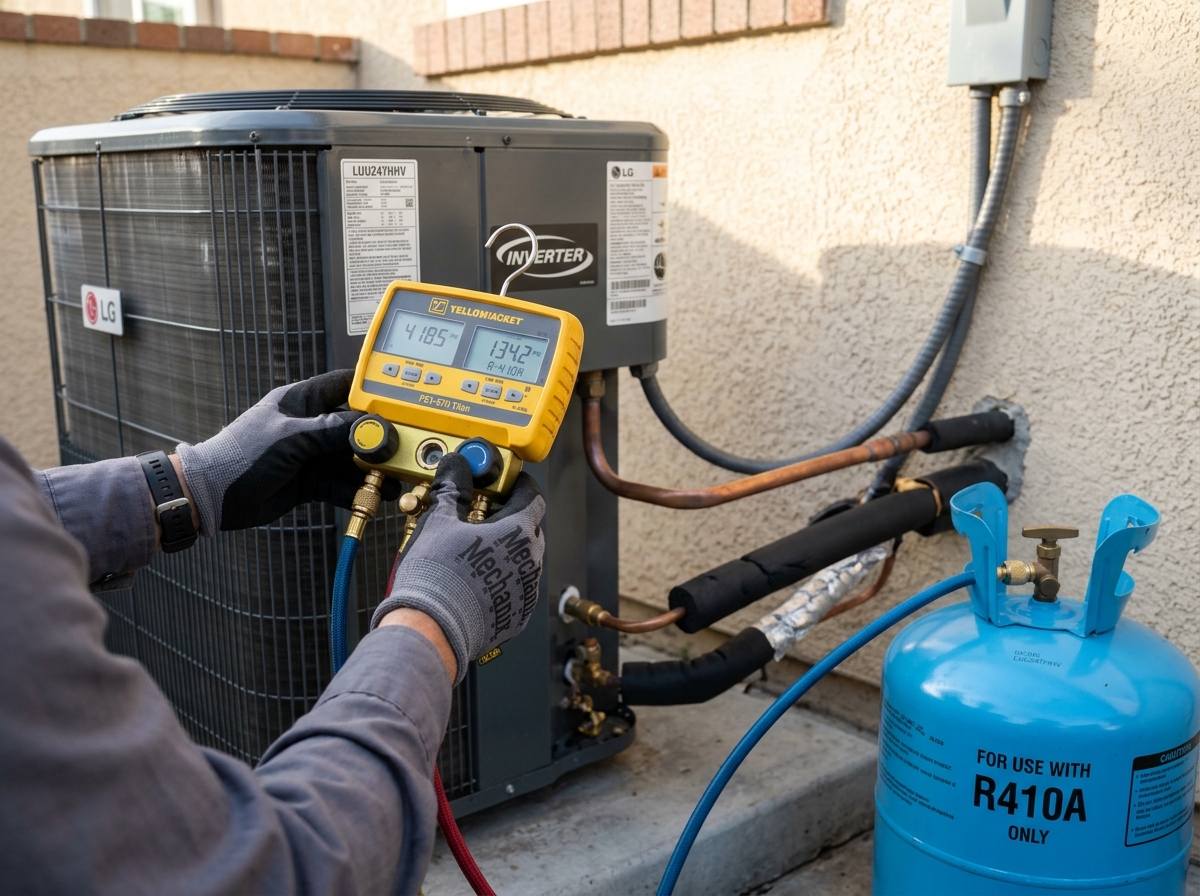
Over 80% of split AC warm-air failures trace back to three mechanical faults: a failed compressor start/run capacitor (outdoor fan spins while the compressor hums briefly), refrigerant loss from a copper flare leak (white frost on the small liquid pipe), or dust-packed outdoor coils tripping the thermal overload switch.
How Closed-Loop Air Conditioning Breaks Down Under Heat
Few household emergencies disrupt sleep and business faster than a split AC suddenly shifting from crisp cold airflow to lukewarm or hot gusts in the middle of a Saudi summer afternoon. Most homeowners immediately lower the remote setpoint down to 16°C hoping the room will cool faster—but dropping the thermostat never creates colder supply air; it simply forces an already stressed system to run non-stop.
Every split AC depends on a sealed thermodynamic loop: liquid refrigerant evaporates inside the wall unit to absorb indoor heat, gets compressed outdoors, and rejects that thermal energy through aluminum condenser fins. When dust, electrical voltage dips, or pinhole gas leaks interrupt any link in that chain, your wall unit turns into a simple room fan recirculating hot air.
The 5 Most Frequent Reasons a Split AC Blows Warm Air
Across more than 10,000 service callouts logged by Top Cleaners field teams in Khamis Mushait, Abha, Jazan, and Hafar Al-Batin, five root faults account for nearly every cooling outage:
1. Blown Compressor Run Capacitor: This small metal cylinder stores electrical surge energy to start your compressor motor. Intense rooftop sun and grid spikes cause internal dielectric fluid to swell. When it fails, the outdoor fan spins normally, yet every two minutes you hear a faint low hum or click followed by silence as the compressor fails to turn over.
2. Refrigerant Leak & Undercharge (R410A / R22): Healthy air conditioners never consume gas; any drop in pressure confirms a pinhole leak at brass flare nuts, service valves, or corroded U-bends. Tell-tale clues include hissing gurgles indoors and white frost or solid ice coating the thin copper liquid pipe outside.
3. Compacted Sand & Dust Blocking Condenser Fins: In desert regions such as Bisha and Hafar Al-Batin, fine dust bonds with evening moisture into a clay-like mat sealing outdoor fins. Heat cannot escape, head pressure spikes above safe ratings, and the compressor’s internal thermal overload shuts the machine down within minutes.
4. Accidental Remote Mode Change: Household members or children frequently toggle Mode away from the snowflake Cool icon into Fan Only or Heat (sun icon), telling the reversing valve to warm the room instead.
5. Seized Condenser Fan Motor: When an outdoor fan bearing locks up or its dual capacitor weakens, heat stays trapped inside the condenser cabinet, tripping the high-pressure protector in under sixty seconds.
Diagnostic Comparison Table: Symptoms, Repairs & Market Pricing
Match what you see or hear at home against the diagnostic benchmark table below used by Top Cleaners field supervisors:
| Visible Symptom | Probable Technical Fault | Certified Field Fix | Estimated Cost |
|---|---|---|---|
| Outdoor fan spins normally, compressor hums every 2 mins & clicks off | Failed Start/Run Capacitor | Replace with OEM Japanese/Korean microfarad-matched capacitor | 120 - 180 SAR |
| White frost or solid ice coating thin outdoor copper pipe | Refrigerant Leak & Low Pressure | Nitrogen 350 PSI leak detection, silver brazing, vacuum & pure R410A | 180 - 280 SAR |
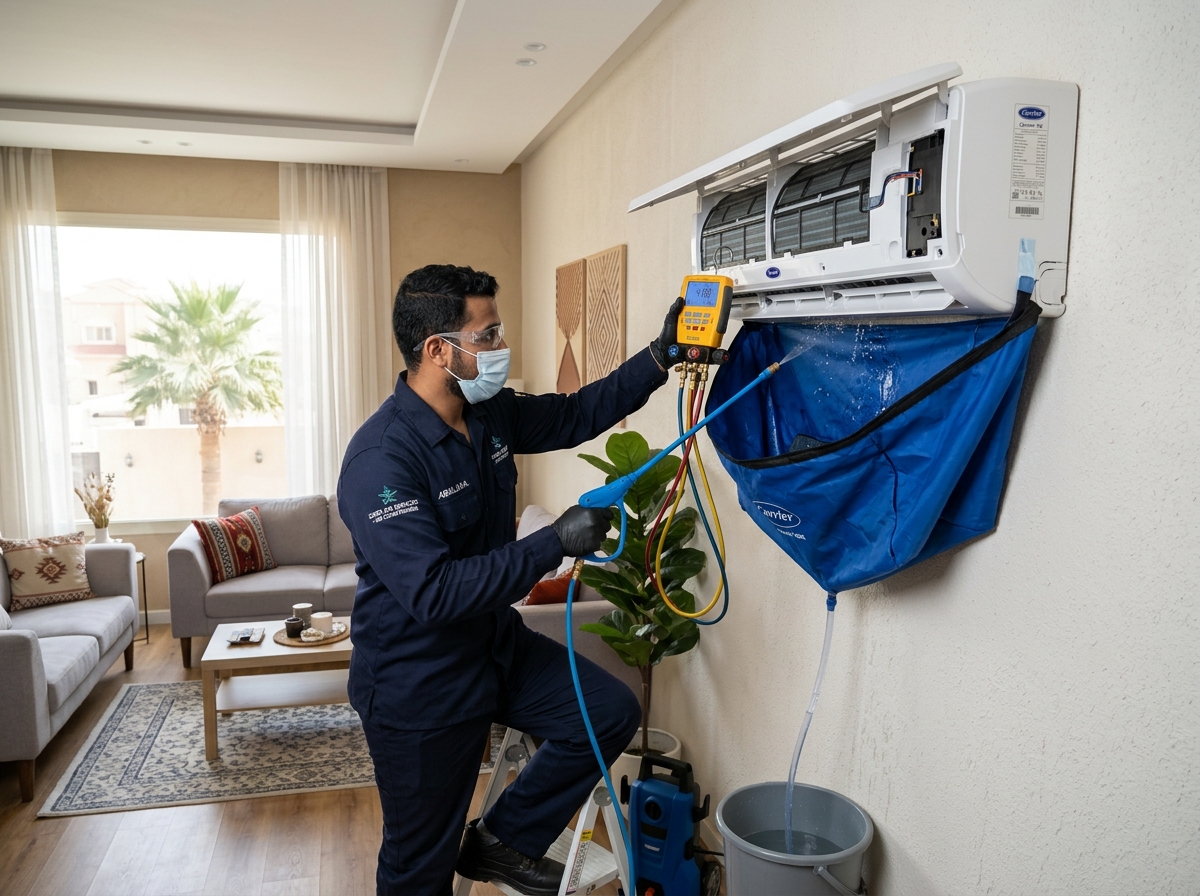
| Unit cools well morning/night then blows warm at noon heat | Clogged Condenser or Weak Fan | High-pressure Karcher fin wash or OEM outdoor fan motor swap | 99 - 300 SAR |
| Airflow stays ambient with scorching compressor top housing | Tripped Thermal Overload Switch | Cool down compressor, check winding resistance & clean loose lugs | 140 - 220 SAR |
| Hot air flows out even though remote displays Cool 20°C | Stuck 4-Way Reversing Valve | Test solenoid coil voltage and replace defective reversing assembly | 250 - 400 SAR |
4 Safe Home Checks Before Calling an Emergency Technician
Before booking an urgent dispatch visit, spend two minutes verifying these safe user-level checks that solve roughly one in five callouts without cost:
- Verify Remote Settings: Confirm the snowflake icon (Cool) is highlighted, temperature sits around 21°C–23°C, and Timer/Eco locks are cleared.
- Inspect the Distribution Breaker: Check your main wall isolator and breaker panel—a tripped 20A/32A switch sometimes leaves indoor lights glowing while starving the outdoor condenser.
- Rinse Indoor Mesh Filters: Slide out both top wall filters; matte gray dust blankets choke return air and freeze indoor coils.
- Clear Outdoor Cabinet Obstructions: Ensure boxes, shade tarps, or garden clutter sit at least 60 cm away from outdoor air intakes and top discharge grilles.
Why Leaving a Warm-Air AC Switched On Destroys the Compressor
Never leave a unit running overnight when it stops cooling hoping it will recover by morning. Cold returning refrigerant gas actually cools the electric compressor motor windings internally. Once gas runs low or head pressure surges, oil breaks down into corrosive sludge and motor varnish burns out—turning an affordable 150 SAR capacitor or leak repair into an expensive compressor replacement exceeding 60% of a new unit’s cost. Power off the isolator immediately and schedule a digital manifold check.
Direct Service & Pricing Links
Frequently Asked Questions
Is it safe to replace a split AC capacitor as a DIY project?
No. Capacitors hold hazardous high-voltage charges even after breakers are turned off, and installing an incorrect microfarad rating slowly overheats and damages expensive compressor windings.
How fast does Top Cleaners fix warm-air AC faults on site?
Most capacitor replacements, nitrogen flare repairs, and Karcher washes take 30 to 50 minutes on site because our service vans stock standard OEM capacitors, brazing torches, and digital gauges.
Why does solid ice build up on the thin copper pipe outside?
Insufficient refrigerant drops evaporator boiling temperature below 0°C, causing ambient humidity to freeze first along the narrow high-side liquid line and then creep into the indoor coils.
Do you issue a written warranty against repeat refrigerant leaks?
Yes—we never top up gas blindly. Every refill follows a 350 PSI nitrogen leak test and flare tightening, backed by a written 3-month gas warranty on your ZATCA invoice.