R410A vs. R22 & R32 Refrigerants: Pressures, Oil Compatibility & SASO Rules
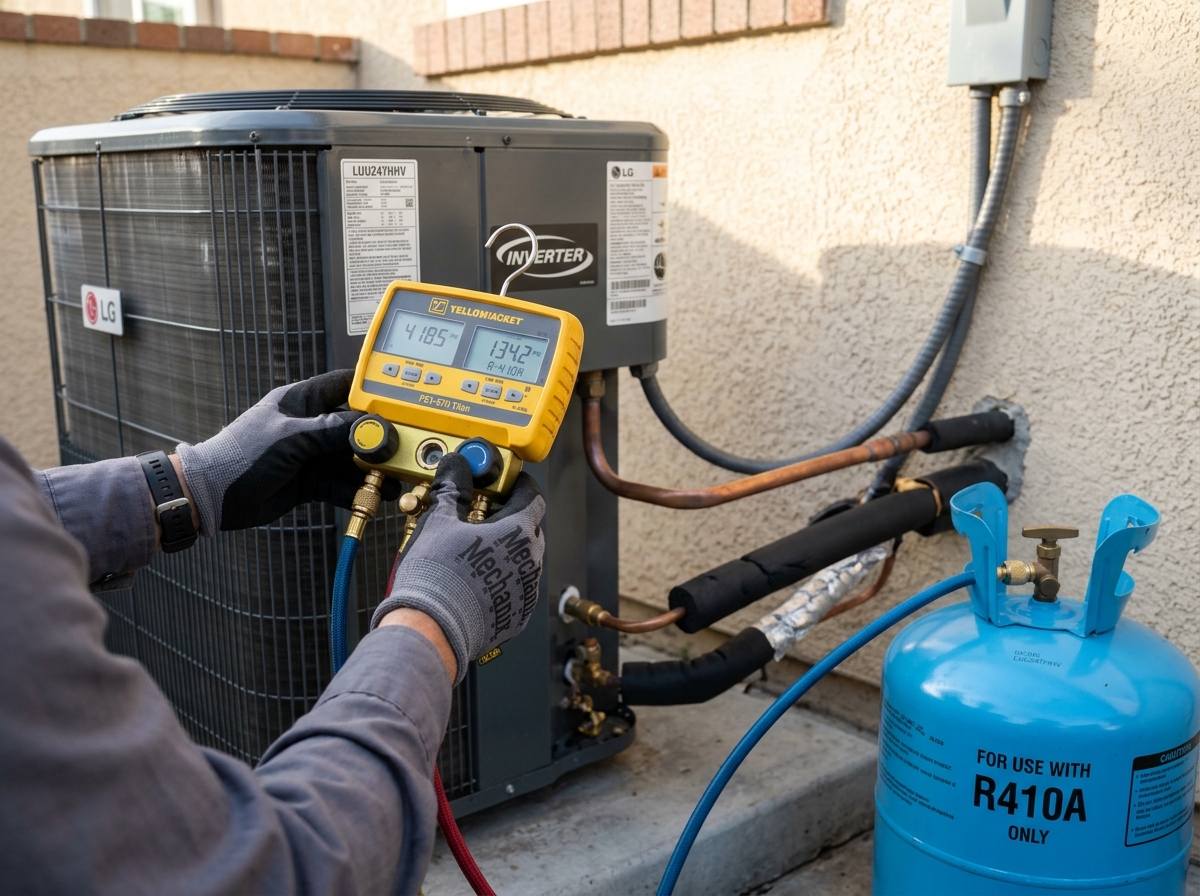
R410A operates at 60% higher pressure than phased-out R22 (118–132 PSI vs. 58–68 PSI suction) with zero ozone depletion (ODP=0), while next-gen R32 boosts cooling efficiency by 10% and cuts global warming impact by 68%. Mixing mineral and POE synthetic oils destroys compressors within hours.
Regulatory Shift & Montreal Protocol Enforcement in Saudi Arabia
In fulfillment of Saudi Arabia's commitments under the Montreal Protocol and strict enforcement by the Saudi Standards, Metrology and Quality Organization (SASO) alongside ZATCA Customs, manufacturing and importing new air conditioners running on chlorine-based R-22 (HCFC) has been completely phased out. Imported R-22 canisters remain tightly restricted solely to servicing legacy residential and commercial equipment.
R-410A has served as the baseline engineering standard across virtually all split units, rooftops, and package HVAC equipment supplied throughout the Kingdom over the past decade. Today, high-efficiency inverter splits are rapidly migrating toward single-component R-32 refrigerant—making it essential for facility owners to understand the sharp physical differences between all three refrigerants so roadside technicians do not ruin costly compressors.
- R-22 (HCFC): Contains ozone-depleting chlorine (ODP = 0.055); subject to quota phase-down and rapidly rising canister costs.
- R-410A (HFC Blend): A 50/50 near-azeotropic blend of R-32 and R-125 with zero ozone impact and dramatically higher operating pressure.
- R-32 (Pure HFC): Single-component modern refrigerant offering 8%–10% higher energy efficiency, lower charge weight, and straightforward top-ups without fractionation loss.
Physical Engineering Differences & Summer Operating Pressures
R-410A carries significantly greater volumetric cooling capacity than R-22, enabling manufacturers to shrink compressor displacement and heat exchanger size while pushing cooling output higher. However, that thermal efficiency comes with roughly 50% to 60% higher operating pressures across both suction and discharge copper circuits.
During a 45°C summer afternoon in Saudi Arabia, an R-22 split unit runs at roughly 60 to 70 PSI on the low-pressure suction line, whereas an R-410A machine operates between 118 and 132 PSI—with high-side discharge pressures surging to 380–450 PSI compared to 240–270 PSI for legacy R-22 units.
Because of these extreme pressure differentials, attaching lightweight R-22 hoses or manifold gauges onto an R-410A system creates severe burst hazards and service-valve seal damage.
| Engineering Property | R-22 (Phased Out) | R-410A (Current Standard) | R-32 (Next Generation) |
|---|---|---|---|
| Chemical Composition | Pure single component (HCFC) | 50% R-32 / 50% R-125 Blend | Pure single component (HFC) |
| Ozone Depletion Potential (ODP) | 0.055 (Ozone Harmful) | 0.000 (Ozone Safe) | 0.000 (Ozone Safe) |
| Global Warming Potential (GWP) | 1810 | 2088 | 675 (68% Lower) |
| Suction Pressure at 40°C Ambient | 58 - 68 PSI | 118 - 132 PSI | 115 - 130 PSI |
| Discharge Pressure at 40°C Ambient | 240 - 270 PSI | 380 - 440 PSI | 370 - 425 PSI |
| Required Compressor Oil | Conventional Mineral Oil | POE Synthetic Ester Oil | POE / PVE Synthetic Oil |
| Service Charging Method | Vapor or Liquid Phase | Liquid Phase Only (Inverted Tank) | Vapor or Liquid Phase |
| Saudi Market Cylinder Cost | Very High (Restricted Quota) | Moderate & Widely Available | Standard for Modern Units |
Why Mixing Refrigerants or Skipping Vacuum Pumps Destroys Compressors
One of the costliest shortcuts committed by uncertified technicians is attempting to top up an older R-22 unit using R-410A under the false claim that R-410A is 'colder and stronger,' or mixing cylinders when refrigerant runs low.
Doing so inflicts fatal mechanical failure within hours due to oil miscibility chemistry. R-22 compressors circulate traditional mineral oil, which cannot dissolve into R-410A refrigerant. Once R-410A enters an R-22 loop, lubricating oil stays stranded inside the evaporator coils instead of returning to the crankcase—starving bearings and seizing the compressor rotor permanently.
Furthermore, POE synthetic oil inside R-410A and R-32 machines is aggressively hygroscopic, pulling moisture straight out of humid air. Leaving copper pipes unsealed for more than 15 minutes during repairs causes POE oil to hydrolyze into hydrofluoric acid that strips winding enamel inside the hermetic motor and causes short-to-ground burnouts.
- Zero Cross-Compatibility: R-22 can never be replaced with R-410A inside the same compressor and capillary/expansion architecture.
- 500-Micron Vacuum Rule: R-410A circuits must be evacuated down to 500 microns with a dedicated two-stage vacuum pump and digital micron gauge before charging.
- Blend Fractionation Risk: When R-410A loses more than 20% of its charge to a leak, the lighter component escapes faster—requiring complete recovery, leak repair, evacuation, and a fresh scale-weighed charge.
Top Cleaners Certified Refrigerant Charging Standard
Every Top Cleaners HVAC van enforces three mandatory engineering rules on refrigerant diagnostics and recharge jobs across Saudi Arabia:
First, technicians pressurize circuits with dry oxygen-free nitrogen and electronic leak detectors, brazing any pinhole leaks with silver-alloy rods before introducing new refrigerant. Second, we exclusively carry certified Honeywell, Chemours, or European cylinders exceeding 99.8% purity verified by batch documentation—never recycled or hydrocarbon-blended bootleg gas. Third, every unit is charged strictly by gram weight on a calibrated digital charging scale matching the manufacturer's nameplate specification, with R-410A cylinders inverted to meter homogeneous liquid.
Direct Service & Pricing Links
Frequently Asked Questions
Can an R410A system be topped up if it is only slightly low on gas?
Minor drops under 15% can sometimes be trimmed carefully in liquid phase after fixing the leak, though losses exceeding 20% shift the 50/50 R32/R125 chemical ratio and require full vacuum recovery and fresh gram-weighed recharging.
How can homeowners spot counterfeit or contaminated Freon cylinders?
Authentic American or European cylinders carry intact shrink-wrapped valve seals, laser-etched batch codes, and SASO import clearance tags—never rusted repainted shells with erratic resting pressure readings.
Why does an authentic R410A service cost more than old R22 top-ups?
R410A demands thick-wall rated hoses, high-pressure manifold gauges, nitrogen pressure testing, deep 500-micron vacuum pumping, digital scale weighing, and genuine imported synthetic-compatible refrigerant.